
Does your switchboard have a neutral wire?
Most retrofit smart switch modules need a neutral wire at the switch to power themselves. A great many Indian switchboards do not have one. That includes most of Jaipur's housing stock wired before roughly 2010, and plenty wired after. The electrician ran only a live wire to the switch, and took the neutral straight to the light fitting.
It was cheaper. It was legal. It is still the single most common surprise we find on survey, and it is why two identical-looking 2BHKs can quote twenty percent apart.
The good news is that it is not a dead end. There are three workarounds, all of them normal, and you can find out which one applies to your home in about five minutes without calling anybody.
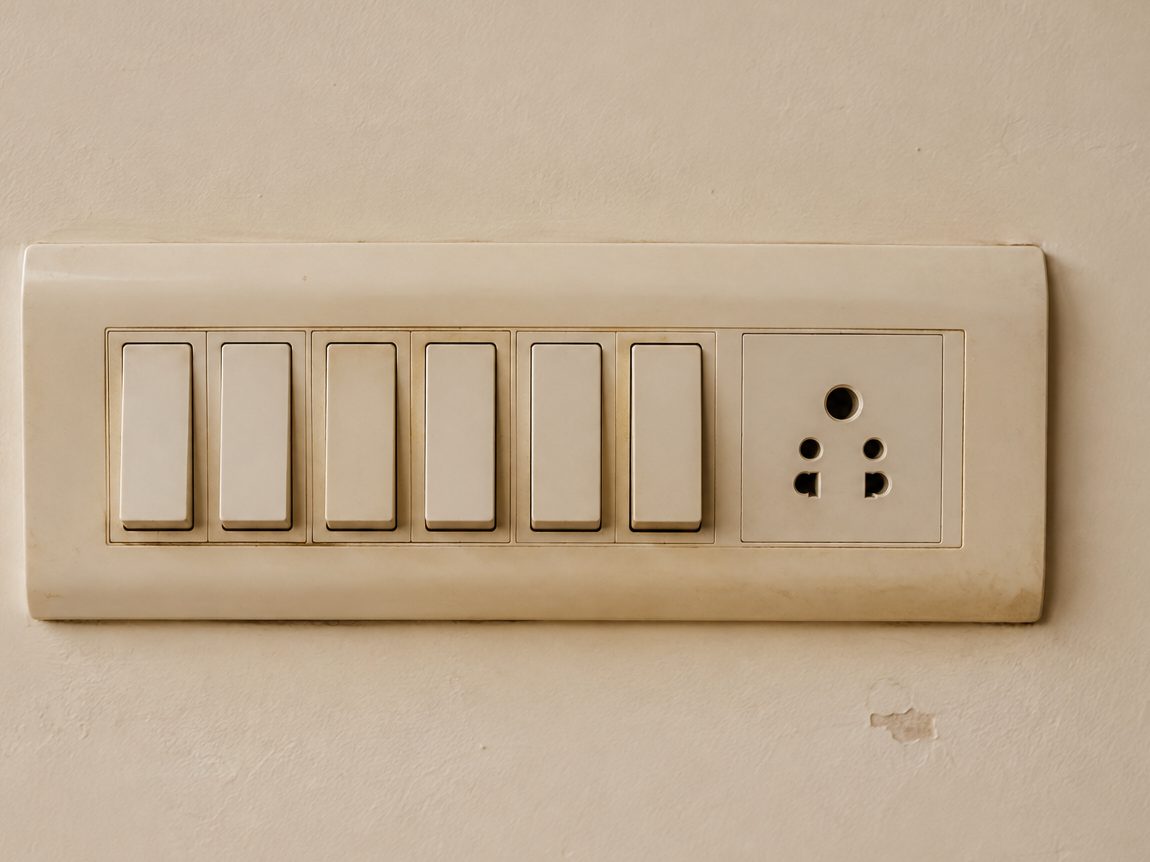
What a neutral wire is, in one paragraph
Mains electricity arrives at your home on two wires that matter here: a live, which carries the supply, and a neutral, which is the return path. A circuit only works when current can flow out along one and back along the other. A normal wall switch does not need the neutral, because all it does is break the live wire. Open the gap and the light goes off. Close it and the light comes on. The switch itself consumes nothing.
A smart switch is different, because it is a small always-on computer. It has to stay powered even when the light is off, so that it can listen for an instruction from your phone or your hub. To stay powered it needs a complete circuit of its own, which means it needs both a live and a neutral present inside the switchboard. If your electrician never brought the neutral to that box, the module has no way to feed itself.
An ordinary switch
The switch does one thing: it breaks the live wire. It consumes no power itself, so it never needs the neutral. The neutral goes straight to the lamp and back to supply, bypassing the box entirely. This is why the wiring was done that way, and why it was legal.
A smart switch
The module sits in the same box but stays awake with the lamp off, so it needs a circuit of its own. That means a neutral inside the box: the thicker branch running up from the return path. If your electrician never ran one to that point, there is nothing for the module to feed from.
How to check your own board in five minutes
You can settle this yourself, for free, before anybody visits. You are looking, not touching.
- Switch the circuit off at the MCB. Not the switch on the wall. The actual breaker in your distribution board. Then test the switch to confirm the light no longer responds.
- Unscrew the switch plate and ease it away from the wall. It will still be attached by wires; do not pull.
- Look into the back box and count the distinct wire colours going into the terminals behind the switch.
- Photograph it with the flash on, straight into the box, before you put anything back.
- Screw the plate back on and restore the MCB.
What you are hoping to see is a spare wire sitting bundled and unused at the back of the box, or a terminal block joining several of them. It is typically black or blue in Indian wiring, though colour conventions are inconsistent enough that colour alone is not proof. That is very often a neutral that has been brought to the box and never used.
What you will often see instead is only red or brown wires going in and out, one per switch, with nothing spare. That usually means no neutral at the switch.
If you are not comfortable opening a switchboard, do not
Nothing on this page is worth taking a risk over. Send us a photograph of the closed plate and the make of the switch and we will tell you what is likely, or wait for the free survey and we will open it ourselves. We do this on every survey as a matter of course.
The three workarounds, and what each costs you
If you do not have a neutral at the switch, you have three honest options. None of them is a disaster, and all three are things we fit regularly.
1. No-neutral modules
These are built for exactly this wiring. They draw a tiny trickle of current through the light fitting itself to keep themselves alive, which is why they do not need a separate return path.
What it costs you: slightly more per point than a standard module, and some fussiness with LED bulbs. A very low-wattage LED can flicker or glow faintly when it should be off, because that trickle is enough to partly light it. This is not a defect and it is not universal. It depends on the specific bulb.
What we do about it: we test your actual bulbs at the survey rather than guessing, and where one misbehaves we will tell you whether it needs a different bulb or a different approach before you buy anything.
2. A different switch family
Some glass touch panels carry their own supply arrangement and sidestep the neutral problem entirely, because the whole plate is replaced rather than a module being hidden behind it.
What it costs you: more money, and your existing plate. If you spent real money on your current switch plates, this is the option that throws them away, which is worth weighing before it is decided for you.
What you gain: no bulb compatibility question at all, and a cleaner install on boards that are too shallow to take a module behind the plate anyway.
3. Pull a neutral
Sometimes there is a neutral within reach, in the same conduit, at a nearby socket, or at a junction a short run away. If there is, this is the cleanest fix of the three, because afterwards your board is simply a normal board and every standard module works in it.
What it costs you: nothing much, if the wire can be drawn through existing conduit. A great deal, if it cannot. Then it means chiselling, and chiselling means patching and repainting. That is the exact thing retrofit exists to avoid.
What we do about it: we check the conduit route at the survey and tell you which of those two it is before you decide, not after somebody has started making holes.
What this does to your price
Broadly: having a neutral is the cheap case, no-neutral modules cost somewhat more per point, and a full switch-family change costs the most. Pulling a neutral is either the cheapest fix or the most expensive one, depending entirely on whether the conduit cooperates.
We are not publishing a precise uplift figure for each option here, because it depends on how many boards are affected. A house with a neutral everywhere except two boards is a very different job from a house with none at all.
What we will commit to is that the answer is established at the survey, in writing, before you order anything. See the published bands
Common questions
Can I just use smart bulbs instead?
You can, and for one or two lamps it is a perfectly sensible answer that costs almost nothing. The catch is the wall switch: if somebody turns the light off at the wall, the smart bulb loses power and stops responding to anything at all. In a household where not everyone is on board, that failure happens daily.
Smart bulbs suit table lamps and rooms with a single fitting. They do not suit a house where you want the switches themselves to be the smart part.
Is a house without a neutral wired badly or unsafely?
No. It was standard practice, it met the code of its day, and it works perfectly well for the job it was built to do, which was switching lights on and off. It only becomes a constraint the moment you want something at the switch that needs continuous power.
Separately: we do sometimes find boards that are genuinely unsafe, and when we do we will say so and decline to build on top of one. That is a different problem from a missing neutral.
Will a bypass capacitor fix the flickering?
Often, yes. A bypass fitted at the fitting gives the trickle current somewhere to go other than through the LED, which stops the faint glow. It is a small part and a normal fix.
We would rather test your bulbs first and use a bypass where it is genuinely needed than fit them everywhere by default, because every extra component in a ceiling rose is one more thing that can eventually fail. What actually fails, and when
Most people are not
ready to book a survey.
That is completely reasonable for a purchase this size. So here are three smaller steps that still get you a real answer, and one that gets you a price.
Send me the price list
One message on WhatsApp, and you get the band sheet back. Every package and add-on, with its working range. No call, no form.
Message on WhatsApp Two minutesSend a photo of your switchboard
Open the plate, photograph the wiring, send it. We will tell you whether you have a neutral wire. That single fact moves your price more than anything else.
Send a photo Ten minutesTalk it through on a call
Ring us and describe the house. We will tell you honestly whether what you want is a ₹40,000 job or a ₹4,00,000 one before anybody drives anywhere.
+91 92143 14348 The real answerBook the free survey
We come to your home, open a board, measure the windows, and give you a room-by-room design with a real number. Free, and you owe us nothing afterwards.
Book a survey