
A sensor light is only good if you get to set the trigger.
Most sensor fittings arrive with the trigger fixed at whatever the factory decided, which is why so many of them end up switched off at the wall. Ours are adjustable on site: how much movement sets it off, how far it reaches, and how long it stays on after the last movement. A basement wants thirty seconds. A porch wants five minutes. Nobody should have to live with one number for both.
- Working price band
- ₹1,800 – ₹4,500 per sensor
- Stair lighting
- ₹6,000 – ₹18,000 per flight
- Time on site
- Under an hour per sensor
- Civil work required
- None for sensors. See stairs below
- Works without internet
- Yes, the sensor switches the light directly
Sensitivity, reach,
and how long it holds.
These are the only three things that decide whether a sensor light is a relief or an irritation. We set all three with you standing in the room, and we will come back and change them once for free if the room turns out to behave differently from how it looked on install day.
Sensitivity
How much movement counts. Turn it up and a cat sets it off; turn it down and it misses somebody walking slowly. A porch that faces a windy street needs a different setting from a windowless basement, and the two are not close.
Reach
How far it looks, and how wide. This is what stops a bathroom sensor firing every time somebody walks past the open door, and what stops a garage sensor triggering on the street outside.
Hold time
How long it stays on after the last movement it saw. The setting people get wrong most often, in both directions. Thirty seconds is right for a passage and badly wrong for a bathroom.
Stair lights are the one
job that might need chiselling.
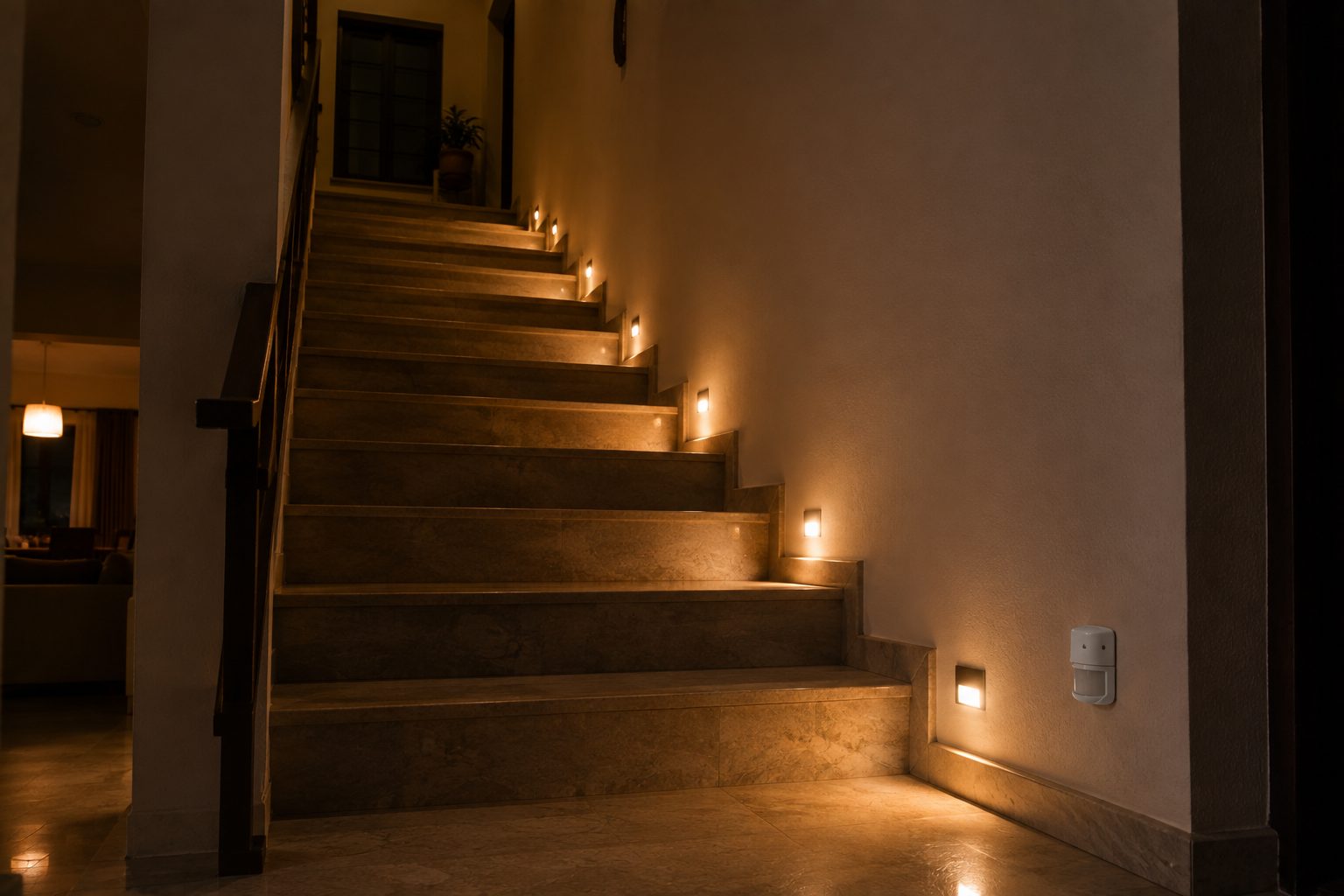
Everything else on this site is a genuine retrofit. The module hides in a back box that already exists and no wall gets touched. Recessed step lights are the exception. To sit flush in the side wall of a staircase they need a hole and a cable route, and in a finished house that means chasing the wall and making good afterwards.
We will not pretend otherwise to win the job. There are two ways round it, and we will show you both at the survey with what each actually looks like on your stairs:
Surface-mounted, no chiselling
A slim warm strip tucked under the nosing of each tread, or a single well-placed fitting at the top of the flight. No civil work at all, and from standing height you see the light rather than the fitting. This is what most people choose once they have seen the alternative priced.
Recessed, during other work
Genuinely the better-looking result, and the right answer if your interiors are still open or the stairwell is due for paint anyway. If neither is true, the making-good usually costs more than the lights.
Either way, the sensor is free-standing
The sensor at the foot of the flight mounts on the surface and needs no chasing, whichever lighting option you pick. The chiselling question is only ever about the step lights themselves.
Send us a photo of the stairwell before you decide
Stand at the bottom of the flight, photograph straight up, and send it over. We can usually tell from one picture whether surface-mounted will look right on your particular stairs, and roughly what each option costs, without anybody driving anywhere.
Five rooms where nobody
should be finding a switch.
Porch & entrance
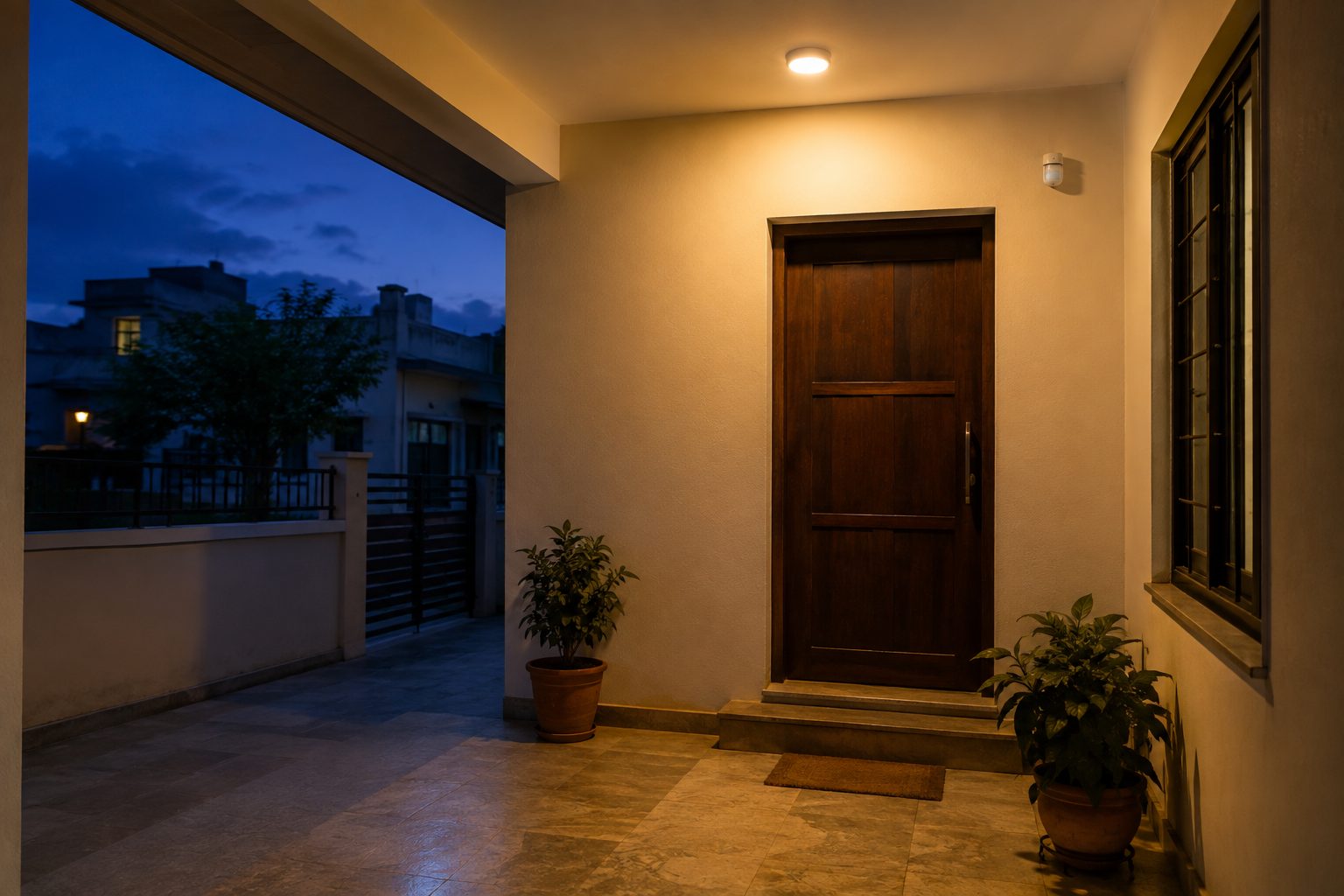
On before you are at the door with your hands full, off five minutes after the last person is inside. The one people notice every single day.
Bathroom
The room where hold time matters most, because somebody standing still in a shower is not movement. We set this one longer than feels necessary, deliberately.
Basement & store
Short hold, high sensitivity. You are in there for ninety seconds looking for something, and the light should not need a decision from you at either end.
Garage & parking
Reach set narrow so the street does not trigger it, and long enough that it stays on while you are getting bags out of the boot.
Office & study
The room most likely to be left burning all day. A sensor here pays for itself on the bill rather than on convenience.
Stairs & landing
Lit before your foot lands, off a minute after you are up. Nobody feels along a dark wall, and nobody leaves the stairwell on all night because walking back down was too much trouble.
What the price includes
- The sensor, fitted and wired to the light it controls
- Sensitivity, reach and hold time set with you in the room
- One free return visit to re-tune the settings after you have lived with it
- A manual override at the wall, so the light can always be forced on or off
- First-year cover on top of the manufacturer warranty
What it does not include
- Chiselling or making good for recessed step lights
- New light fittings, unless quoted as part of the job
- Running a fresh circuit where no lighting point exists
- Outdoor sensors rated for direct rain without a covered mount
- Rectifying a lighting circuit found unsafe at survey
Three things people
want to know first.
Will it turn off while I am still in the bathroom?
Not if the hold time is set properly, and this is the single most common complaint about sensor lights fitted by somebody else. A person standing in a shower registers as almost no movement, so a thirty-second hold that works perfectly in a passage fails badly in a bathroom.
We set bathroom sensors long on purpose, and we would rather you told us it stays on too long than have you standing in the dark. That is what the free return visit is for.
Can I still use the switch normally?
Yes, and we fit it so you can. The wall switch stays where it is and still forces the light on or off by hand, which matters when you want a porch light on all evening for guests, or a basement light off while somebody is working in there.
This is the same rule we apply everywhere on this site: automation is control added, never control taken away.
Does it need Wi-Fi or an app?
No. A sensor light in its simplest form is a sensor wired to a light. It works with your broadband unplugged and with no account anywhere. Plenty of the sensors we fit never touch a network at all.
You may want the sensor to do more than switch one light, such as trigger a scene, notify you, or behave differently after midnight. Then it needs to join the system, and we will say so before you buy it rather than after.
Most people are not
ready to book a survey.
That is completely reasonable for a purchase this size. So here are three smaller steps that still get you a real answer, and one that gets you a price.
Send me the price list
One message on WhatsApp, and you get the band sheet back. Every package and add-on, with its working range. No call, no form.
Message on WhatsApp Two minutesSend a photo of your switchboard
Open the plate, photograph the wiring, send it. We will tell you whether you have a neutral wire. That single fact moves your price more than anything else.
Send a photo Ten minutesTalk it through on a call
Ring us and describe the house. We will tell you honestly whether what you want is a ₹40,000 job or a ₹4,00,000 one before anybody drives anywhere.
+91 92143 14348 The real answerBook the free survey
We come to your home, open a board, measure the windows, and give you a room-by-room design with a real number. Free, and you owe us nothing afterwards.
Book a survey